
San Marcos City Directory Holdings
The local shelf is uneven, but it is still workable. One collection is verified at CSUSM. Other city directory holdings are regional, digitized, or identified only through a catalog lead that needs a title-page check. The table separates what is documented from what still requires a reference request.
| Collection | Years | Where Held | Access |
|---|---|---|---|
| CSUSM institutional directories | 1989-2021 | CSUSM University Archives, shelf KEL 1006 11.a.4 | Noncirculating reading room; request some digital surrogates |
| San Diego Public Library volumes | 1886-2021 holdings; selected digital years | Central Library Special Collections and digital archives | Library collection; selected free online volumes |
| Escondido, San Marcos, and Valley Center lead | 1979 and 1986 catalog leads | Regional genealogy and library leads | Verify publisher, scan, and geographic coverage |
| Federal population census | 1850-1950 public schedules | NARA and library genealogy access | Name, age, birthplace, relationship, occupation |
| Telephone and criss-cross volumes | Exact San Marcos years unverified | County and city library reference collections | Ask staff to confirm title page and run |
The CSUSM run is an affiliation directory, not proof of a person's home. The San Diego Public Library digital volumes are principally for San Diego and must not be treated as San Marcos coverage without a scan that says so. Those limits are part of a sound San Marcos city directory result.
Why San Marcos Uses Regional Directories
San Marcos incorporated in 1963. Earlier evidence was kept under San Diego County and regional systems, so a city directory search may sit beside county deeds, subdivision maps, telephone books, census schedules, and newspapers rather than in a long city-run series. The valley's older history also changes its address language. Rancho and county descriptions came before later lots, tracts, and named streets. A directory entry can be meaningful only after its geography is tested.
The research did not locate an official catalog-verified list of standalone San Marcos publishers and year runs. It also did not provide an inspectable local residential entry. Do not invent Polk years. Ask the San Diego County Library, San Diego Public Library Special Collections, San Diego History Center, or CSUSM Special Collections to confirm the title page, publisher, covered towns, and shelf location before citing a volume.
A regional source can still help. It may place a family in a North County address, provide a telephone clue, or point to a later deed, obituary, yearbook, or newspaper. The source must be labeled regional when San Marcos coverage is not printed on the volume.
Read a San Marcos City Directory Entry
R.L. Polk format from an official 1953-54 San Diego volume gives useful regional evidence about how one city directory may read. The alphabetic resident section can show a name and address, a wife or widow notation, an occupation, and a business officer or owner description. Its Householders or Street and Avenue Guide runs by street, intersecting street, and numbered location. It may name a householder or business and mark an owner or renter. Publisher notes warn that canvass data can contain errors and omissions.
| Name | Head of household, with spouse or widow notation when the publisher used one. |
|---|---|
| Occupation | Work or trade description attached to the entry; wording follows the publisher's key. |
| Address | House number and street, sometimes with a residence or boarding abbreviation. |
| Owner mark | A symbol or note may flag homeowner versus renter in that run. |
| Street guide | Address-first section that can connect a house number to a named person or business. |
- Criss-cross directory
- An address-first section that reverses the name-first lookup and may expose a householder or telephone clue.
- Householder index
- A directory's index of people or households, often distinct from a business list.
- Abbreviation key
- The publisher's own guide to marks such as residence, boarding, owner, or widow; never borrow a definition from another volume.
- Index versus image
- A typed name or address finding aid is not the same as the scanned page that contains the entry.
The sample format explains how to read a source. It does not prove that the 1953-54 volume covered San Marcos. A San Marcos city directory claim needs the local volume's title page or catalog record.
CSUSM San Marcos Directory Collection
CSUSM University Archives holds California State University San Marcos directories from 1989 through 2021 in two linear feet at KEL 1006 11.a.4. The run includes the 1989 telephone directory, 1990-91 joint and interim editions, Spring and Fall 1991-92 editions, Fall editions from 1993 through 2000, academic-year volumes from 2001/02 through 2009/10, and selected later years including 2011/12, 2012/13, and 2014/15. Unit runs cover parts of 1990-2007 and later.
Some 1989-2000 and unit-year material may be requested as a digital surrogate. The archive is noncirculating. A request uses the folder title, box number, proposed appointment date, and researcher contact information. The reading room is at 333 S Twin Oaks Valley Road, San Marcos, CA 92096. Contact archives@csusm.edu or (760) 750-4312.
The collection can place a person in a campus role or unit during a defined year. It should be paired with a residential source rather than described as a complete city directory.
The verified archive finding aid is the safest place to begin for CSUSM-affiliated research.
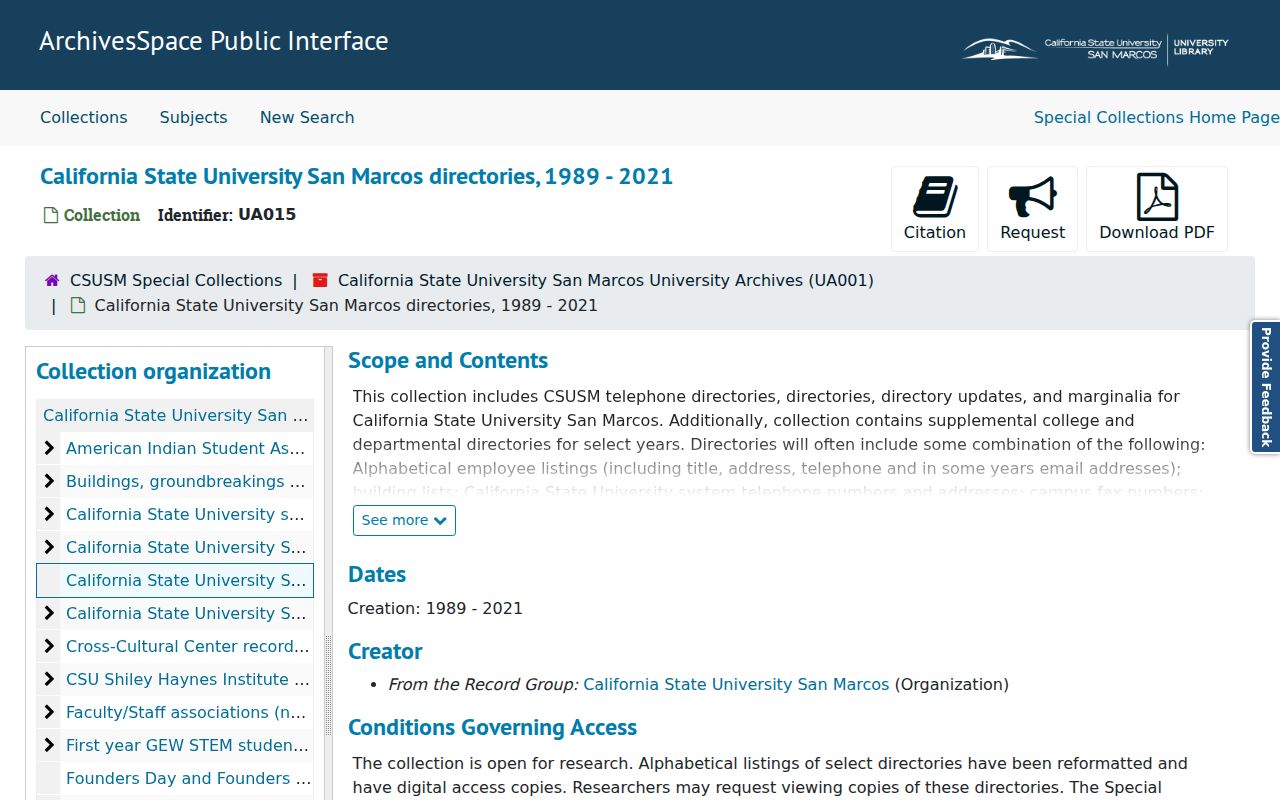
The collection image reflects an institutional directory trail, with access controlled by archive request and reading-room rules.
Digitized San Marcos City Directory Volumes
San Diego Public Library Central Library Special Collections states that its city-directory holdings span 1886 through 2021. Its official digital archive lists 1874; 1926-43; 1944-45; 1947-48; 1950; 1952; 1953-54; 1955 suburban; 1956-58 city and suburban; and 1959-60 suburban volumes. Those are valuable regional scans, but the 1956 R.L. Polk suburban volume expressly lists Chula Vista, Coronado, El Cajon, La Mesa, Lemon Grove, and National City, not San Marcos.
Open a scan's title page before searching its names. Check the geography statement, publisher, year, index, and street guide. A digital page that contains a San Diego County name is not automatically a San Marcos resident directory. Historical newspaper databases, Sanborn collections, and library genealogy tools can add context, but each source has its own coverage.
The official collection page is the source for the available digital-year list.
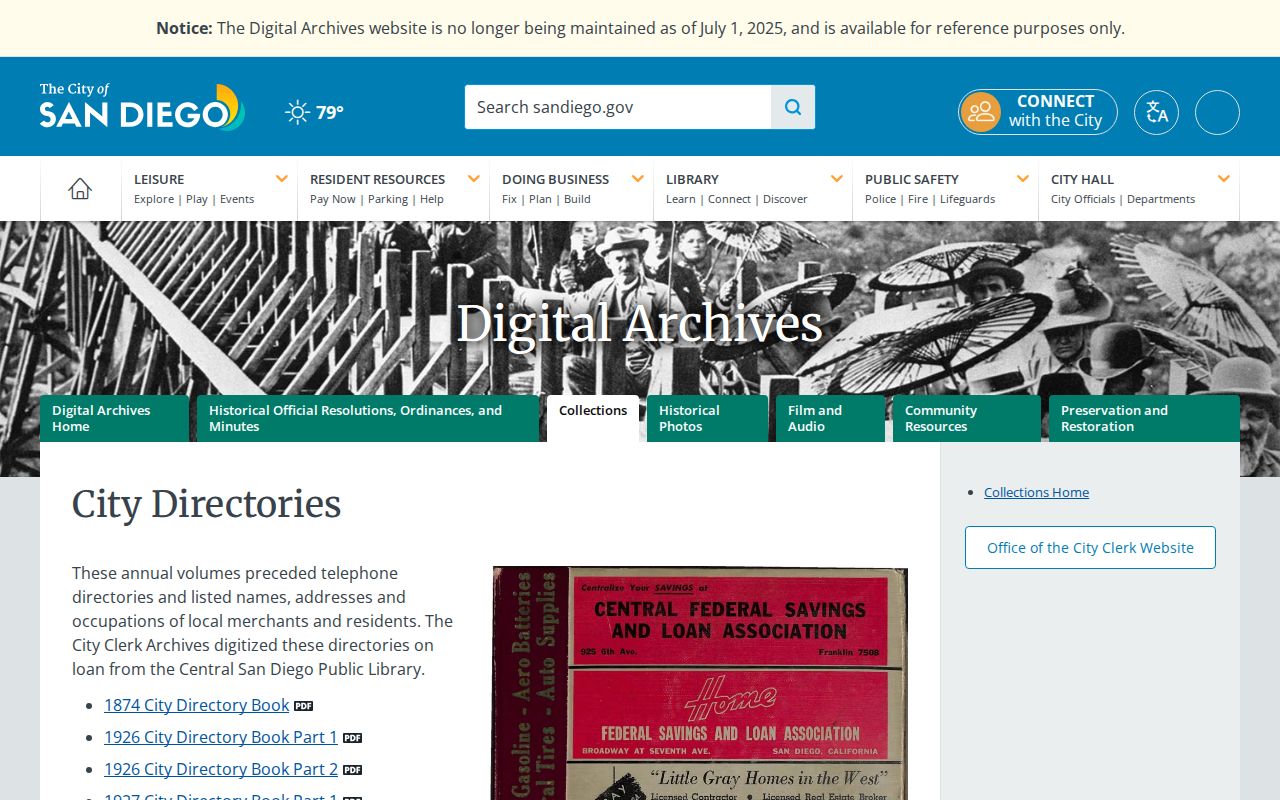
The scan path is free to inspect, while the geographic label determines whether a result belongs in a San Marcos family history.
Trace a San Marcos Directory Household
A city directory works best as a year-by-year bridge between decennial census schedules. The directory may show a move, a spouse notation, a telephone, or an owner mark that the census does not. The census may supply age, birthplace, relationship, and occupation that the directory leaves out. Use the two records to test a household, not to assume that a name stayed with one address.
- Read the title page and confirm the volume's geography, year, publisher, and abbreviations.
- Find the person's name in the alphabetic section and copy the entry exactly.
- Follow the name in the next available edition, noting address, spouse, widow, and occupation changes.
- Flip to the street or criss-cross section to test the address and nearby entries.
- Pair the directory dates with the 1950 census or another lawful source, then close the trail with a newspaper, obituary, deed, or probate file.
If a name disappears, possible explanations include a move, death, unlisted status, a coverage gap, a changed surname, or a publisher error. A later deed can anchor the parcel, while an obituary or probate petition can identify a relationship. The San Marcos resident lookup workflow is the better handoff when the historical clue becomes a one-person verification task.
Bridge San Marcos Directory Gaps
When a volume is absent, the county record chain can carry the address forward. ARCC Archives holds deed series from 1846 through 1969, while the web index begins in 1970. Assessment material, subdivision maps, permits, newspapers, obituaries, and census schedules can place a person or household in the interval. The legal description or APN is the stable bridge when a street label changes. For state-level government history outside that county chain, the California State Archives catalog is a separate finding path.
Sanborn map coverage is not verified for a standalone San Marcos sheet run, and exact local telephone-directory years remain unresolved. The California Collection at San Diego Public Library holds more than 800 maps and regional material, but rural coverage cannot be assumed. A careful request states the address, earlier legal description, date range, and desired record series.
San Marcos Library and Chamber Sources
San Marcos Library reference staff can check local newspapers, yearbooks, telephone books, Ancestry Library Edition, MyHeritage Library Edition, and regional local-history material. The branch is at 2 Civic Center Drive, San Marcos, CA 92069, (760) 891-3000, and sanmarcoslibrary@sdcounty.ca.gov. Published hours in the research were Monday 10-6, Tuesday and Wednesday noon-7, Thursday 10-6, and Friday through Sunday 10-5, subject to recheck.
The San Marcos Chamber directory is a business and organization affiliation layer. It searches by keyword, category, and A-Z and can expose an organization, address, telephone, website, and sometimes a representative. It is not a household roll. The Chamber is at 251 N City Drive Suite 128G, San Marcos, CA 92078, (760) 744-1270, info@sanmarcoschamber.com.
The Chamber's public directory has a different purpose from a city directory.

Use it to confirm an organization or public contact, then return to a record custodian for any resident claim.
Ask Before Citing a San Marcos Directory Year
A current city website redesign or a library catalog change can move a search path without changing the underlying collection. The city's January 2026 website launch is a reminder to use a current canonical link and to check whether an older domain redirects. For directory research, ask the library or archive to confirm the title page, publisher, covered places, shelf mark, and whether a scan is complete.
CSUSM Special Collections also holds oral histories and community material from northern San Diego and southwestern Riverside counties from 1989 forward. CSU Digital Archives can be faceted by San Marcos campus for photographs, letters, and oral histories. These sources add human context to a city directory search while preserving the distinction between institutional affiliation and residential proof.
The official city notice records the current public-service access path.
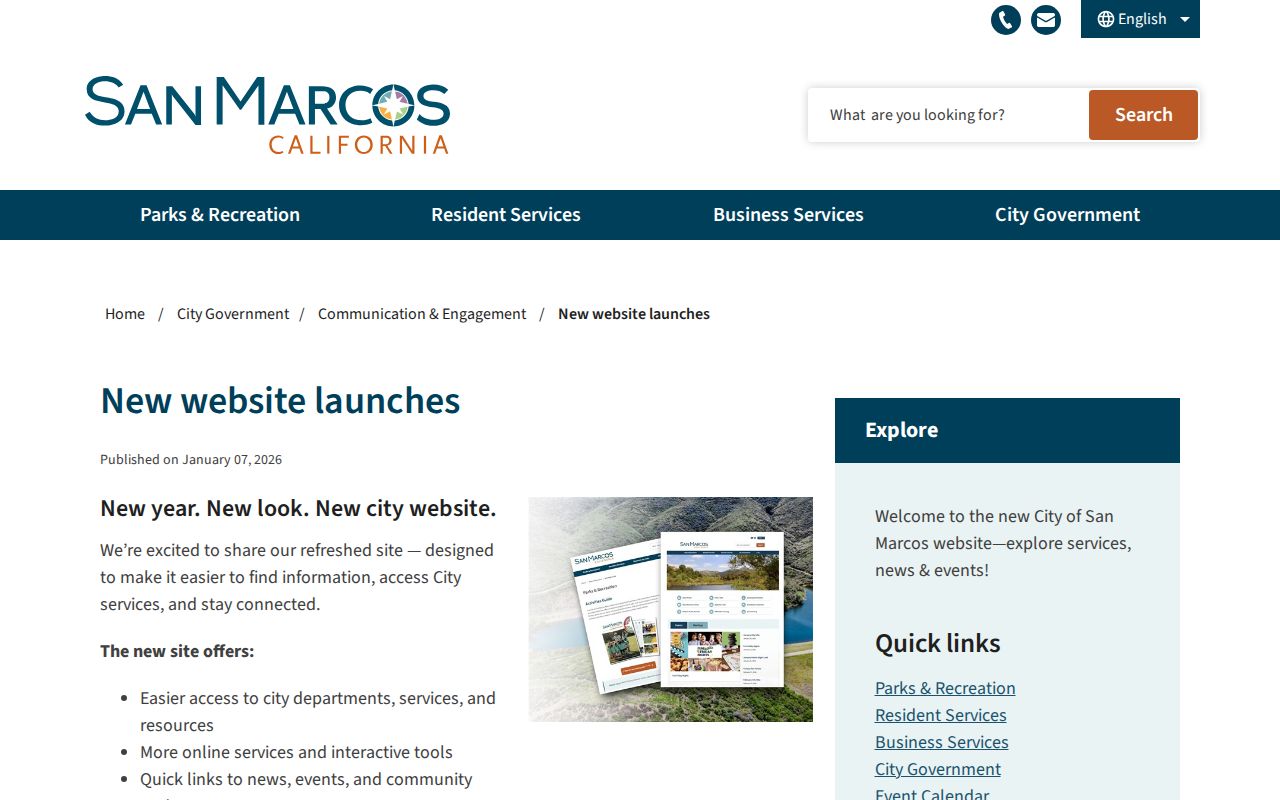
Keep the source date beside any page or catalog result, especially when a historical collection is still being verified.