
Sources for San Marcos Previous Residents
A reliable past-household trail moves across several custodians. The first rows identify land and ownership. The later rows add occupancy, family, and date context. Coverage is not the same as availability, so keep the source's limits beside its years.
| Source | Years It Covers | Where Held | What It Shows |
|---|---|---|---|
| ARCC web index | 1970-present | Official Records Index | Indexed parties, document type, date, and parcel references when displayable |
| County Archives deeds | 1846-1969 | ARCC Archives, Santee | Historical deed books, party indexes, legal descriptions |
| Assessment and maps | Current and archived years by request | Assessor, GIS, Archives | Parcel, value, subdivision, mailing clue, map context |
| Census schedules | 1850-1950 public | NARA and library access | Named household, age, relationship, birthplace, occupation |
| Directories and criss-cross | Exact local years unverified | Libraries and regional collections | Address-to-occupant or name-to-address clue |
| Probate and obituaries | Case or title dependent | Superior Court, newspapers, libraries | Death, heirs, relationships, notices, final trail |
The sequence turns a parcel into a time line without calling every owner a resident. For previous residents, that distinction is the center of the research.
Start with Today's San Marcos Parcel
Use the address in San Diego County GIS and the secured assessment roll. Record the APN, situs address, legal description, subdivision or tract, unit, and current parcel context. The tax mailing address may differ from the situs. It can suggest an out-of-area owner, but it cannot prove who lived at the property.
GIS can show parcel geometry, APN, document date, acreage, subdivision, situs ZIP, jurisdiction, street, building, and physical traits. It does not contain an owner-name or owner-mailing field in the inspected San Marcos layer. The assessor is the route for lawful ownership or mailing information, subject to California privacy limits. This foundation lets previous residents be traced by land rather than by a guessed surname.
- Chain of title
- The linked sequence of ownership transfers for one legal parcel.
- Grantor
- The party transferring an interest in a recorded instrument.
- Grantee
- The party receiving an interest in that instrument.
- Legal description
- The parcel description that controls the land identity when a street label changes.
Search a San Marcos Owner as Grantee
Search the ARCC Official Records Index for the current owner as grantee, using a plausible acquisition period and document type. Record the document number, recording date, grantor, grantee, legal description, book and page where shown, and any associated references. Confirm that the lot or subdivision matches. A same-name party is not enough.
The web index is free to search from 1970 forward. Newly recorded documents may take 24 to 48 hours to appear. A free index is not a free image. Images can be viewed at ARCC kiosks or obtained through an ordered copy. The Recorder's stated fees are $2 for the first page, $0.05 for each additional page, and $1 for certification, with a card surcharge.
Recorder copying and recording guidance explains the difference between an index finding and a document request.
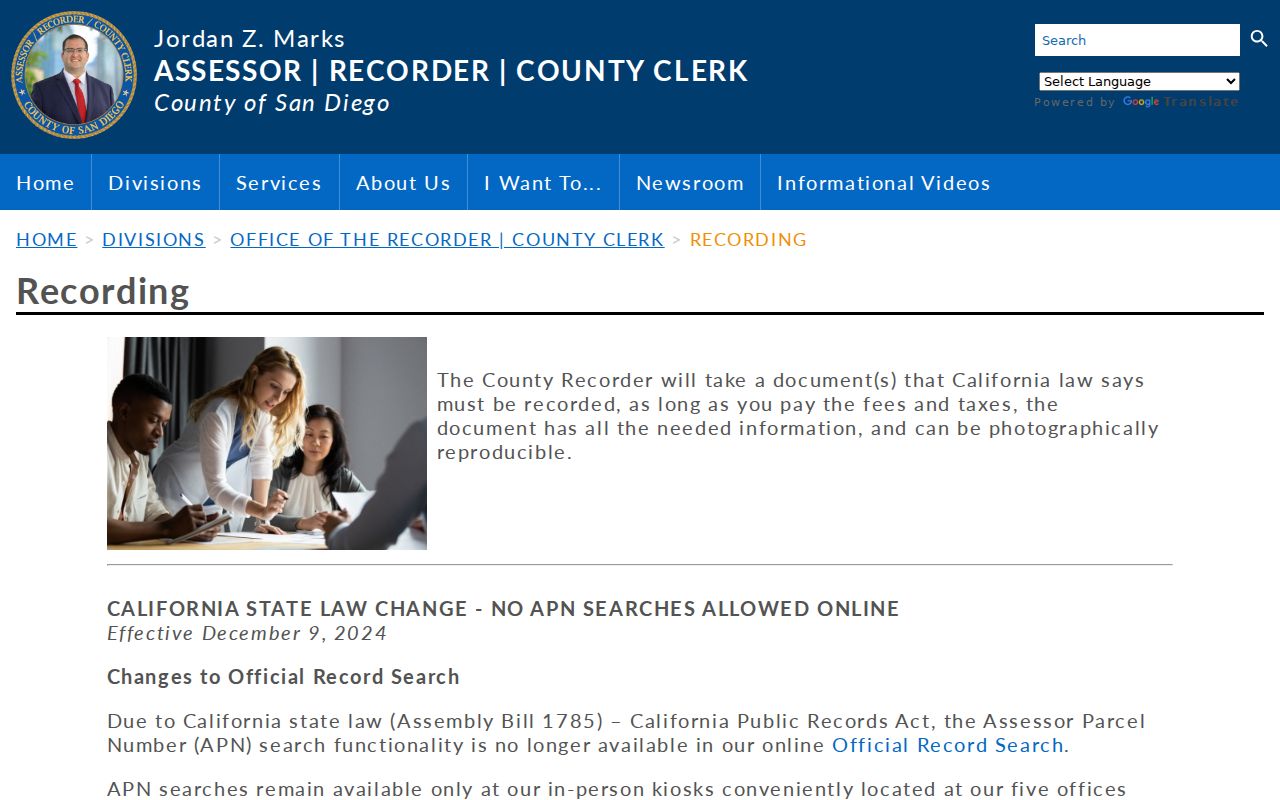
Use the document number and legal description from the result when moving from a name search to the official copy path.
San Marcos Sellers and Past Buyers
Once the current acquisition deed is identified, take its grantor and search that name as an earlier grantee. Repeat the loop: each seller may be the prior buyer. Search backward by date, compare the legal description, and watch for trust, estate, corporation, and partnership roles. A deed of trust records financing, not a change of owner.
- Write the current grantee, grantor, document date, number, and legal description in one row.
- Search the grantor as grantee in an earlier date window.
- Compare lot, block, subdivision, APN reference, and vesting language.
- Repeat until the web index ends or the parcel identity becomes uncertain.
- Switch to Archives books, numeric indexes, maps, and microfilm for older transfers.
A title chain identifies owners. Directories and census schedules are needed to test who occupied the house between transfers. This is why the previous residents trail cannot be reduced to a deed list.
San Marcos Archives Beyond 1970
ARCC County Archives holds deeds from 1846 through 1969, numeric indexes from 1872 through 1973, and recorded maps. Official Records material overlaps from 1931 through 1989, which can help bridge the 1970 web cutoff. The Archives overview also describes earlier official records from 1848 through 1959, with handwritten or typed deed, chattel-mortgage, lease, bond, and miscellaneous books.
Archives are at 10144 Mission Gorge Road, Santee, open Monday through Friday 8-5, with (619) 237-0502 and archives@sdcounty.ca.gov. Original maps remain in Santee, while images can be accessed through ARCC kiosks. Historical birth and death holdings span 1849-1986, and marriage holdings 1856-2020, but those collections are closed for browsing and certificates must be ordered through ARCC.
The County Archives FAQ shows the older-record and map bridge behind a past-resident search.
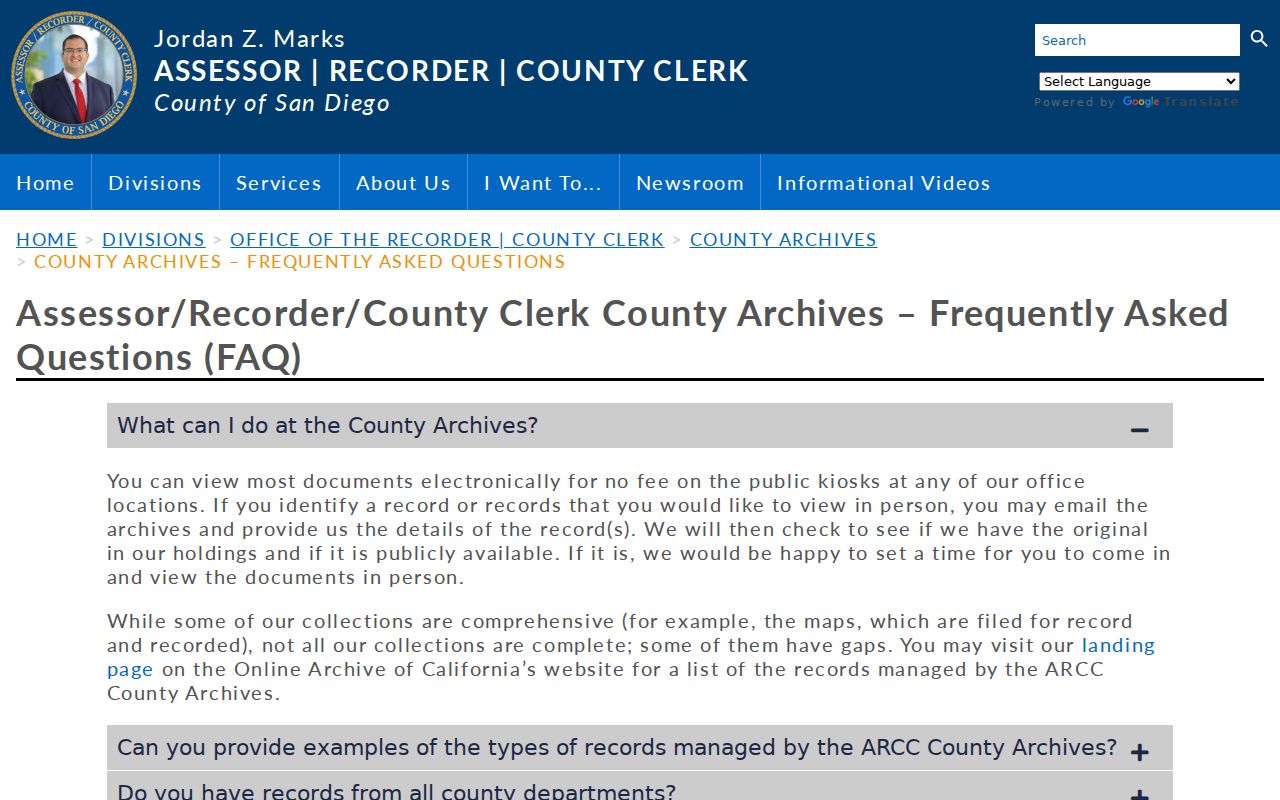
The archive path is the way to move beyond a web cutoff without pretending that an older record is online.
San Marcos Legal Descriptions
Street labels do not always carry a house history by themselves. San Marcos grew from county and ranch descriptions into subdivisions, tract maps, named streets, and later master-planned neighborhoods. The original town center shifted toward the railroad in 1903. A pre-1903 reference can point to a different town center than a later Mission Road or Pico Avenue description. Carry the APN, lot, block, map book, and legal description through each search.
City Land Development Engineering handles street naming and renaming, map correction, lot legality, street vacation, final maps, and parcel maps. Final maps generally divide five or more lots or units, while parcel maps cover four or fewer. The engineering contact in the research is (760) 744-1050 ext. 5572, 1 Civic Center Drive, with published hours Monday through Thursday 7:30-5:30 and alternating Friday 8-5.
The legal parcel is the stable link when a street directory or an old deed uses a different name.
San Marcos Owner Alert
ARCC Owner Alert is useful after the historic chain is understood. The free service can monitor up to ten names and ten APNs per email and link a future recording to a new index entry. It does not inspect document contents, reverse fraud, or prove that a monitored owner lives at the parcel. Use the recording index or kiosk to read the actual instrument.
For a house-history project, the alert can mark the point at which later research should begin. Save the alert date, name or APN, document number, and source link. Do not treat an alert as a complete list of previous residents.
The county's Owner Alert service is a future-recording notice, not a retrospective directory.
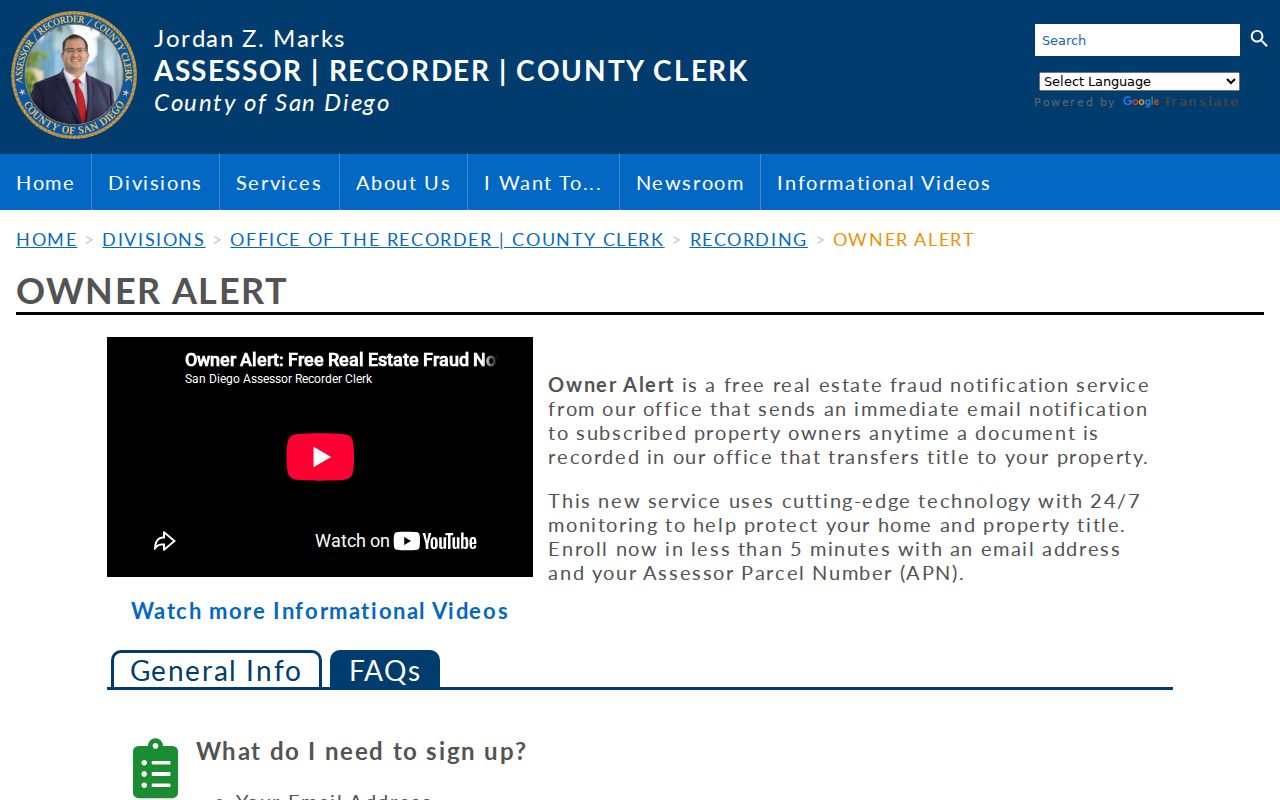
Its narrow purpose makes it a clean supplement to a deed chain rather than a replacement for one.
San Marcos Owners and Occupants
A past owner may have lived elsewhere, rented the parcel, held title through a trust, or transferred it soon after purchase. The census through 1950 can identify named households every ten years. A verified local directory or criss-cross volume can fill an in-between year. Newspapers, obituaries, school yearbooks, and oral histories can supply a family or community clue. Each source should say whether it shows owner, occupant, relative, or affiliation.
The San Diego Public Library and San Marcos Library can help locate regional newspapers, yearbooks, genealogy databases, maps, and directory leads. Exact San Marcos residential directory years remain unverified. A catalog title that includes San Marcos still needs a scan or librarian confirmation. The San Marcos city directory collections page keeps those shelf and geography rules in one place. For previous residents, a confirmed title page is as important as the name search.
San Marcos Permits and Tracts
When a directory misses the address, building permits, inspection history, subdivision maps, and planning packets can date the parcel's development. San Marcos moved newer commercial and building permits to Clariti/Camino on January 2, 2025, while legacy eTRAKiT remains for older activity. A permit may show applicant, contractor, work, issue or final dates, and parcel. Names or attachments can be redacted.
These records establish construction or alteration activity, not a past household. Pair a first permit with a deed, assessment cycle, census year, and any directory entry. A tract map can show when a lot was created even when the street name was not yet used in a family source.
San Marcos Probate and Obituaries
Probate can connect a deceased owner to a petitioner, heirs, notice addresses, and an estate parcel. Search the Superior Court index by decedent, case type, location, and date. An obituary can connect a name to relatives, a former address, or a date of death. Neither source is a substitute for a certified copy, and notice addresses can be old or protected.
San Diego County local registrar and Recorder services divide vital custody. The county can issue birth, death, and public-marriage copies, while CDPH provides state forms and statewide records. Informational copies are broadly orderable for many non-confidential events; authorized copies use statutory relationship rules. A 2026 county death fee is listed at $26, and the county can issue a Letter of No Record after an unsuccessful search.
The county's local registrar guidance is the proper starting point for a death or birth record request.

Use the custodian's copy class and eligibility rules before treating a vital record as the final link in a family trail.
San Marcos Directory Gaps
The research did not verify a standalone San Marcos Sanborn sheet run, a complete local telephone-directory run, or an official residential entry that can be quoted as a sample. That does not end a house history. Use ARCC's deed and map series, the public census through 1950, assessment history, permits, newspapers, obituaries, yearbooks, and library reference help. Ask a collection holder to confirm geography before citing it.
San Marcos's record history is layered: county deeds begin in 1846, city incorporation came in 1963, the recorder web index begins in 1970, and the court web index generally begins in 1974. The missing years tell the researcher which custodian to try next. A careful statement of uncertainty is stronger than a false continuous list of previous residents. That is the core safeguard in previous residents research.
Lawful house history. Use a past-address trail for genealogy, property history, estate research, and other lawful personal aims. Do not use it to stalk, harass, intimidate, or harm anyone.