
What a San Marcos Resident Lookup Can Confirm
A name search is a sorting task. The record below may confirm a party, parcel, event, filing, or public affiliation, but the same person may appear in more than one role. Start with the narrowest record that fits the question, then seek an independent anchor.
| Record | What It Confirms | Where | Access |
|---|---|---|---|
| Assessment or parcel | Ownership clue, situs, tax mailing destination | County Assessor and GIS | Address or APN; not occupancy proof |
| Recorded document | Party name, transfer or lien date, legal parcel | ARCC and County Archives | Free index; kiosk or paid copy |
| Court index | Name variant, case, date, role, and location | San Diego Superior Court | Free index; file separately |
| Vital record | Event identity, relationship, and date | County, CDPH, or court | Informational or authorized-copy rules |
| Probate file | Decedent, petitioner, heirs, notice address | Superior Court | Index and file limits apply |
| Business or license record | Entity, agent, license status, public contact | SOS, DCA, ARCC, or City | Free index; some filings cost |
| Voter status | Registrant's own status and district tools | California SOS or Registrar | Identity gated or purpose approved |
This is the coverage boundary for a responsible resident lookup. A public record can be accurate and still fail to answer whether a person lives at an address today.
San Marcos Resident Lookup Anchors
Before searching a San Marcos resident lookup, write down two facts that can separate people with the same name. Useful anchors include a middle initial, approximate age, spouse or relative, known street, parcel, business, profession, former surname, or date range. Search variants with and without spaces, hyphens, diacritics, and compound surnames. San Marcos records may use Spanish-language surname order or older recorder abbreviations.
Chronology is just as important as spelling. A court party in 1992, a deed party in 2018, and a business filing in 2024 may belong to three people who share a name. Match the place, record role, date, and legal description before you combine them. An owner mailing line may belong to a manager or trust. A court party may live elsewhere. An obituary is secondary evidence that still needs careful reading.
- Party
- A person or organization named in a court case or recorded instrument; party status is not a residence claim.
- Docket
- The court's event history for a case, including filings, hearings, and other entries when available.
- Certified copy
- A copy issued by the custodian with certification; it is different from a free index view or an informational copy.
- Same-name trap
- An apparent match that lacks a second identity anchor, consistent place, or credible chronology.
San Marcos Court Index by Party
The San Diego Superior Court Index offers Party Name, Case Number, and DA Number modes. Party mode starts with last name and works best with first or middle name, case type, and case location. It generally covers 1974 to the present. Civil, criminal, family, mental-health, and probate categories appear, subject to the court's exclusions.
| Search Field | Type | Required | Notes |
|---|---|---|---|
| Last Name | Text | Yes in party mode | Try spelling and surname variants. |
| First Name | Text | No, strongly advised | Narrows a common surname. |
| Middle Name | Text | No | Initials can separate same-name parties. |
| Case Type | Dropdown | No | Civil, criminal, family, mental health, probate, and subtypes. |
| Case Location | Dropdown | No | County divisions and facilities. |
| Case Number | Text | Yes in number mode | For the stated format, enter the year and full eight-digit sequence without hyphens. |
| DA Case Number | Text | Yes in DA mode | Criminal matters only. |
The search fields are more useful when the name is paired with a date and case type. Do not ask the index to answer a question it was not built to answer.
The official court access guidance explains how the party and case search modes fit a San Marcos resident lookup.
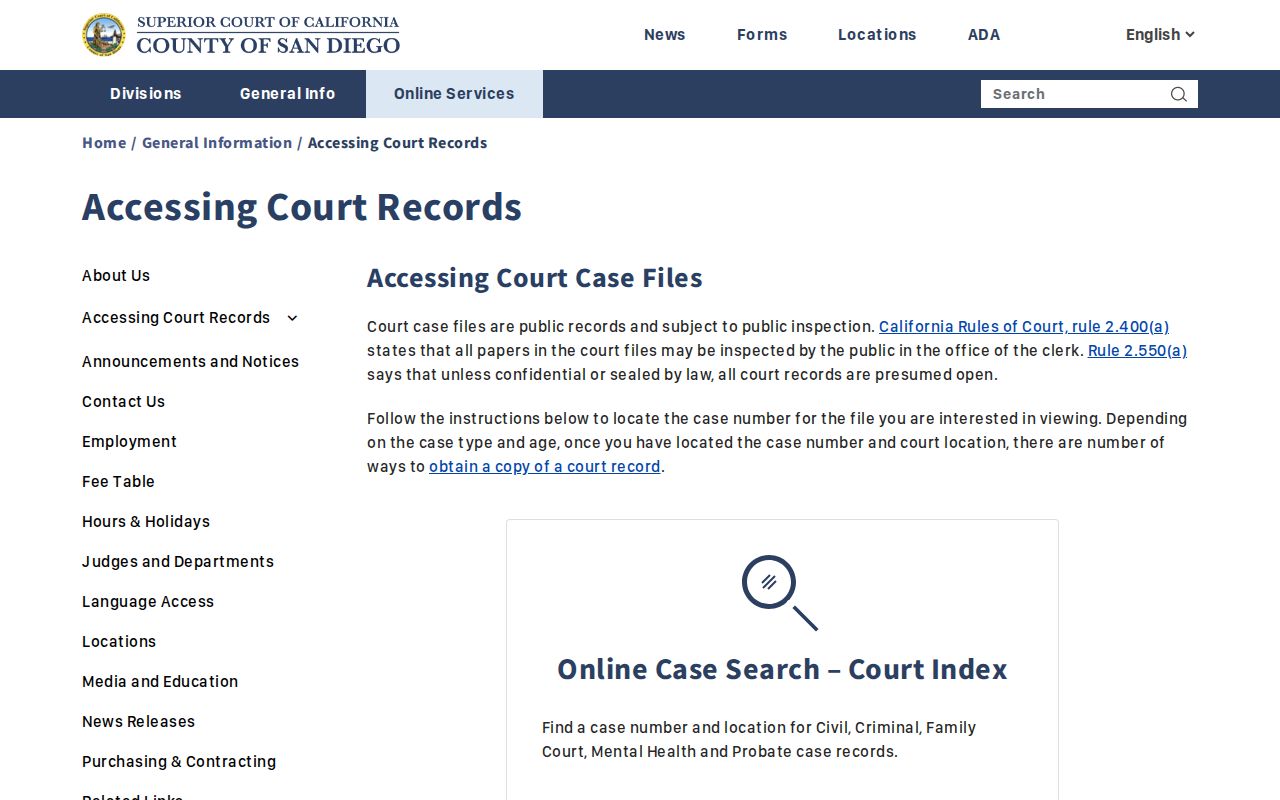
The access page separates online index information from inspection, archive, and copy routes.
The online case-search guidance shows the party and case search modes used in a San Marcos resident lookup.
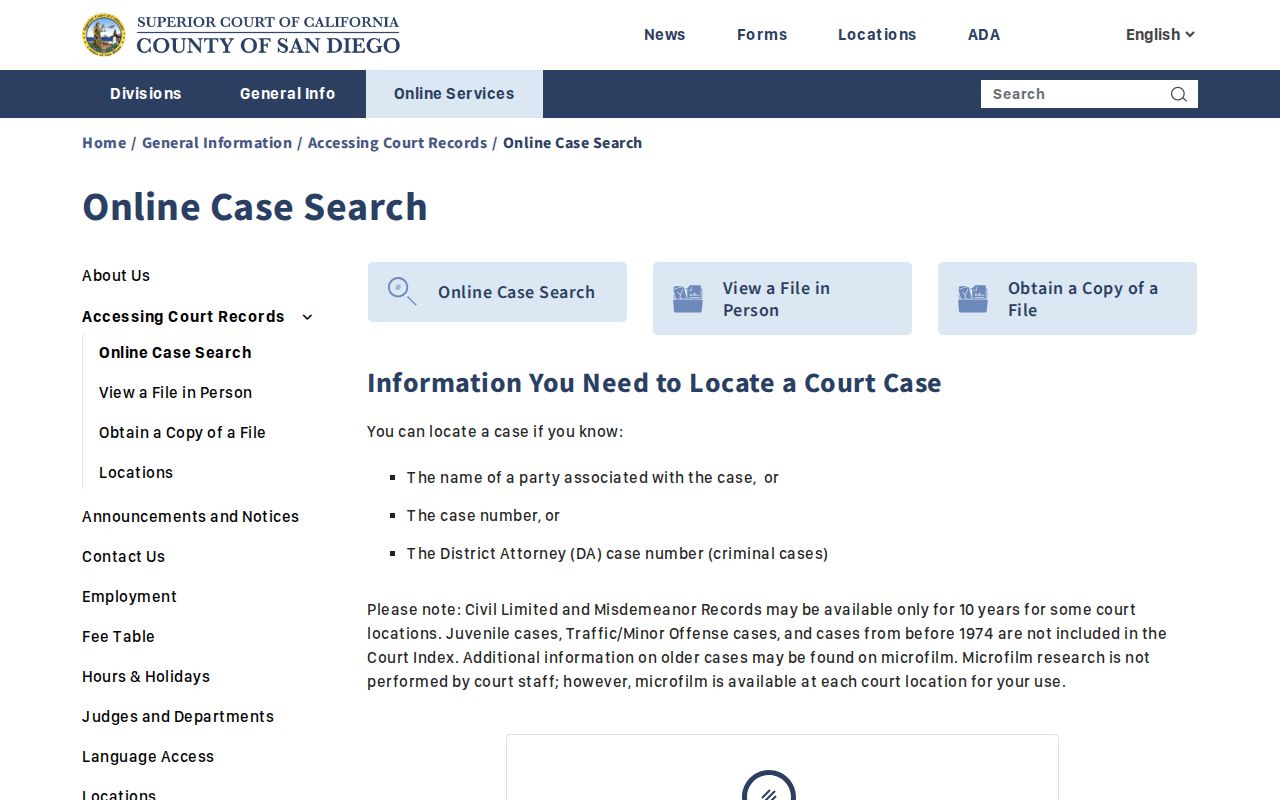
Keep a copy of the result details, then open the court's access guidance before seeking the underlying file.
San Marcos Court Results Need Files
A typical Court Index result can contain case title, case number, filing date, case type, location, party names, and party roles. It does not provide criminal charges or disposition. The Register of Actions may add docket dates, event descriptions, judicial officer, hearings, disposition, and a document-order link. The clerk file is the place to inspect an official record, subject to sealing, redaction, retention, and copy rules.
| Index result | Case title, number, filing date, type, location, parties, and roles. |
|---|---|
| Register of Actions | Docket events, hearings, judicial officer, disposition, and document-order options when available. |
| Clerk file | Official papers, certified copies, and facts not exposed in the online index. |
| Unavailable matters | Juvenile, sealed, confidential, some traffic or minor-offense records, and many pre-1974 online gaps. |
Central Division older records have indexes from 1880 to mid-1974, but staff do not conduct microfilm research. Off-site retrieval can carry a charge. Federal matters for San Marcos belong to the Southern District of California and may be searched through PACER, where the research notes a $0.10-per-page charge capped at $3 per document and a quarterly waiver threshold.
The federal search path is separate from the county court index. The U.S. District Court for the Southern District of California is the court source behind that federal jurisdiction.
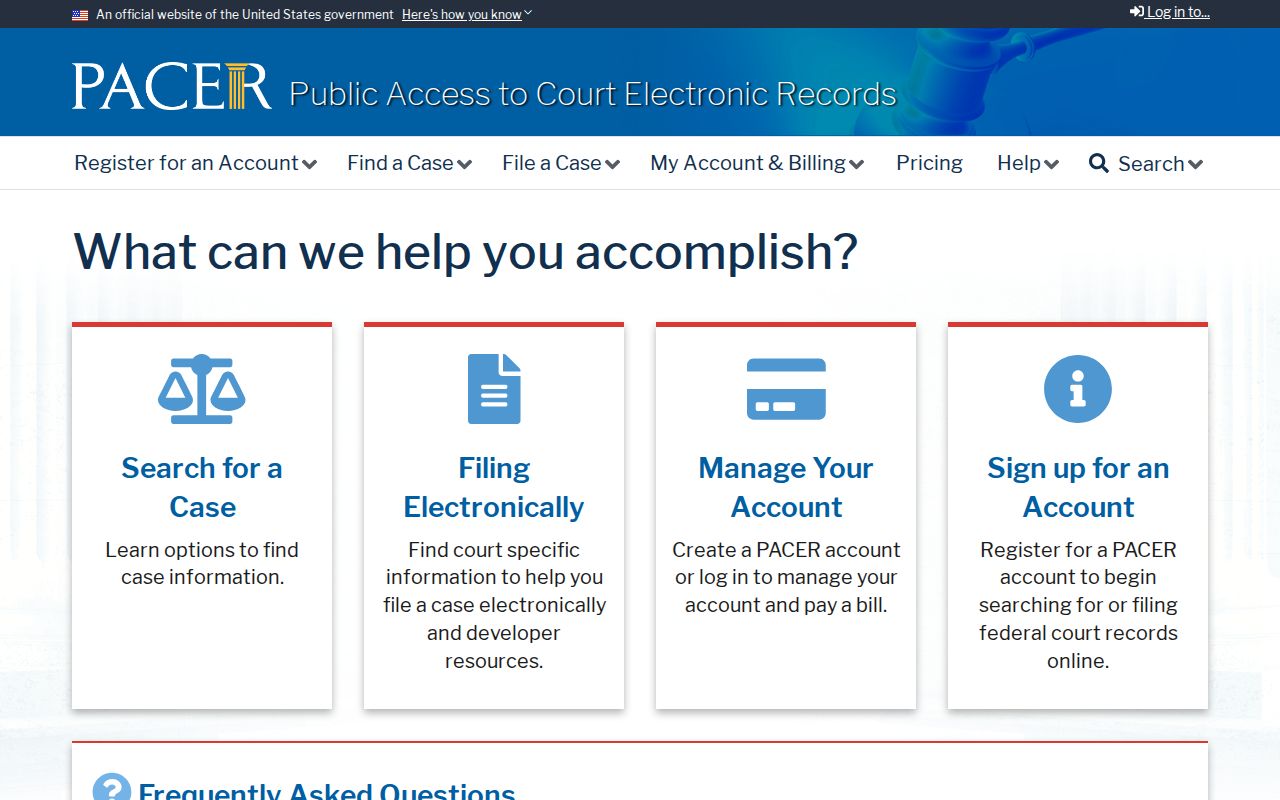
Use the federal source only when the case belongs there, and retain the court and case number with the result.
State custody questions use a different source and identifier. The California Department of Corrections and Rehabilitation incarcerated-person locator can be searched by name or CDCR number, but a state custody result is not a current residence record.
San Marcos Vital Record Copy Rules
California distinguishes an informational certified copy from an authorized certified copy. Most people may order an informational copy of a non-confidential birth, death, or public-marriage record. An authorized copy is limited to statutory relationship classes or listed official roles, and a mailed request needs a notarized sworn statement. Confidential marriage copies are limited under Family Code section 509. Adoption and original amended birth records remain sealed unless a statute or court order permits access.
San Diego County lists 2026 local fees of $34 for birth, $26 for death, and $19 for public marriage. CDPH lists $31 for birth, $26 for death, $19 for marriage, and $18 for a dissolution certificate. An unsuccessful search can result in a Letter of No Record and does not refund the search fee. County birth certificates are available at the San Marcos branch but not Kearny Mesa. Marriage copies should be requested after the returned license registers, with the county advising ten business days.
Use CDPH's VS 111, 112, 113A, and 113B forms when the state is the right custodian. A vital record can confirm an event and relationship, but it is not a broad public resident lookup.
Informational is not authorized. A copy marked informational may help family research but is not the identity-valid authorized copy described by California law.
San Marcos Business and License Search
A public affiliation can provide a useful second anchor. California Secretary of State bizfile searches entity name or number, search type, and status. ARCC fictitious business name records can show a registrant, filing number, date, and public filing address. The Department of Consumer Affairs search accepts board or bureau, license type, license number, first or last name, business name, city, and county. Results can show license number, status, issue or expiration dates, public address, and discipline links.
These sources identify an entity, licensee, agent, or public contact. They do not prove a private residence. Match the filing date, city, role, and business name before connecting it to a court or parcel record. A business or trust can also be a party to a deed without being a person.
The California DCA license search is a direct public affiliation source.
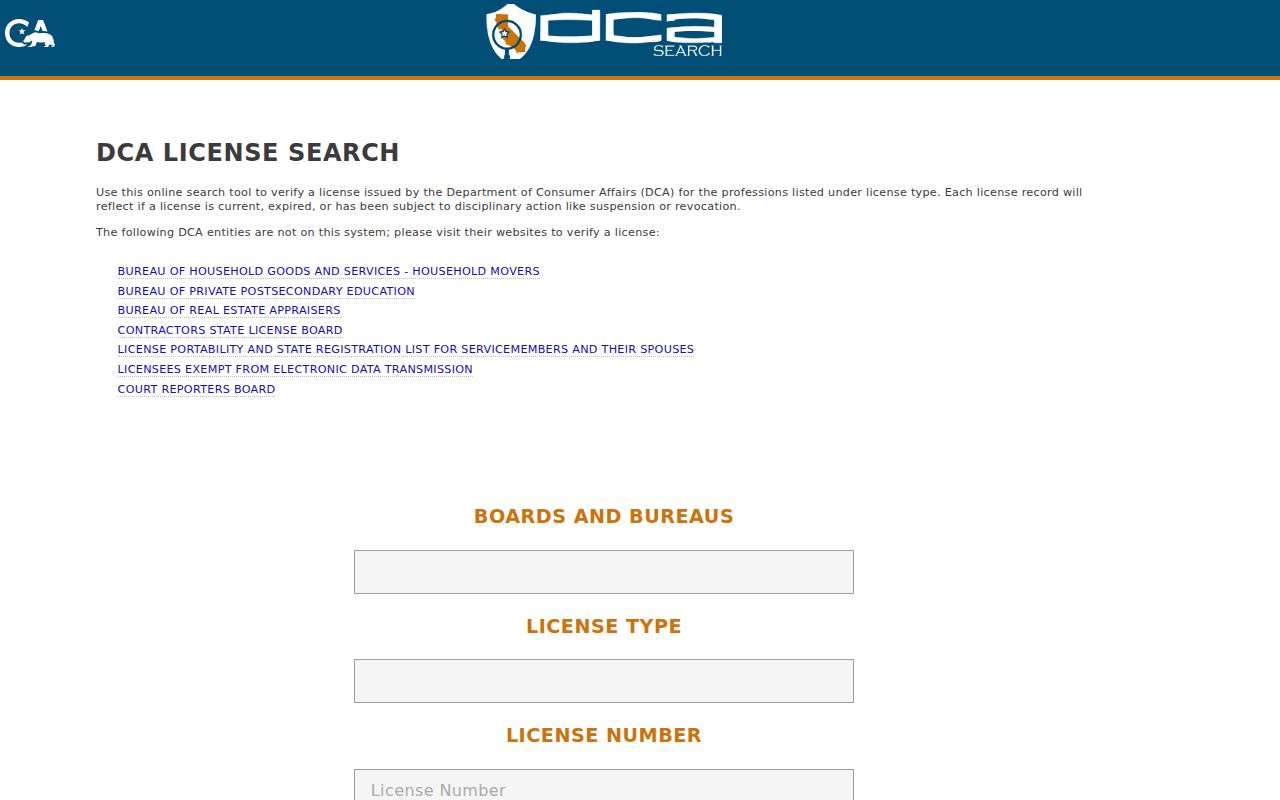
License status and public contact can narrow a name, while the originating board remains the authority for correction.
San Marcos Probate for an Heir
Probate is a focused use of a San Marcos resident lookup when a deceased owner, petitioner, or heir is the known clue. Search the Superior Court index by the decedent's name, case type, location, and date range. A file or petition may identify a petitioner, heirs, notice addresses, and estate property, subject to redaction and confidentiality. Do not treat a notice address as a current home without an independent, current source.
Pair probate with a recorded deed, obituary, and the legal description. A death notice can connect family names, but it is secondary evidence. A deed can show a transfer, but it may list a trust or representative. When the file is sealed or not retained, ask the court clerk what access route remains instead of inferring the missing relationship.
San Marcos Voter Status Path
My Voter Status is for an individual's own identity-gated check. It can return status, party preference, precinct or district, polling or vote-by-mail tools, and related registration information. It does not expose a browsable San Marcos roll. A written file request to the San Diego Registrar of Voters must state an approved election, scholarly, journalistic, political, or governmental purpose.
California Elections Code sections 2188 and 2194 restrict voter-information use. Driver-license or state-ID numbers, Social Security numbers, signatures, and confidential voter data are withheld. Safe at Home participants can register confidentially. Inactive status is not proof that a person moved permanently because list maintenance uses statutory notice and National Voter Registration Act procedures.
That purpose limit is central to any resident lookup. An approved extract is not a casual neighborhood roster and cannot be republished as one.
San Marcos Lookup Corrections
A directory cannot amend an official record. Send a roll question to the Assessor, a recording question to ARCC, a docket issue to the court, a voter-record issue to the Registrar, and a license issue to the board or agency that published it. A focused CPRA request can seek an existing city record when the online portal does not expose it. Under Government Code section 7922.535, the ordinary disclosure determination is within ten days, with a possible written extension for unusual circumstances.
Keep a small evidence log: exact name, variants searched, date, custodian, record number, source URL, and the fact supported. Remove assumptions from the final note. That practice makes a San Marcos resident lookup useful for family history or civic research without turning a lead into an unsupported identity claim.
Lawful personal use. Use public records to research family, history, civic matters, or a lawful reconnection. Do not use a lookup to stalk, harass, intimidate, or harm anyone.
Protected San Marcos Residents
Safe at Home provides substitute addresses and confidential voter registration for qualifying survivors of domestic violence, sexual assault, stalking, trafficking, child abduction, and elder or dependent-adult abuse, along with specified reproductive-health workers and public employees who fear for safety. California Government Code sections 6205 and following and 6215 and following control the program. Property purchased in a participant's own name may still expose a legal description.
DMV personal data is closed under the federal DPPA. Adoption records, confidential marriages, sealed court files, juvenile records, and protected voter details use separate rules. A missing name is not proof of a missing person, and a public record is not permission to evade a confidentiality program.