
Looking Up San Marcos Neighbors
A block question needs a block-sized source. GIS supplies the shape. The assessor may add an owner or mailing clue for each parcel. Permits can show work and applicants. An approved voter file can support a lawful geographic project. Community groups may publish board contacts or events. None of these sources is a complete list of San Marcos neighbors.
| Block Source | What It Shows About a Block | Access |
|---|---|---|
| GIS adjacent parcels | Neighboring geometry, APN, jurisdiction, and layers | Free visual map |
| Assessment roll | Owner or mailing clue, parcel, value, characteristics | Public roll, counter, or request with limits |
| City permits | Address work history, applicant, contractor, inspection status | Current or legacy portal; targeted request |
| Approved voter file | Registrants by lawful geography and stated purpose | Registrar application, not casual browsing |
| Association public page | Board, manager, public events, or community notices | Organization link; member roster usually private |
This table keeps neighbors research at the immediate block level. A whole named-street ownership chain belongs in the San Marcos street directory workflow.
Select Adjacent San Marcos Parcels
Open the San Diego County GIS catalog or the San Marcos GIS hub. Search or geocode the target address, select the parcel polygon, and read the APN, situs, jurisdiction, and subdivision. Then select the immediate side and rear parcels. A buffer or radius, if the application offers one, selects geography only. It does not select people.
The inspected San Marcos Parcel FeatureServer supports Query and Extract, has a maximum record count of 2,000, and exposes no owner-name or owner-mailing field. Related layers can include SiteAddress, Zoning, FloodPlain, and CouncilDistrict. Parcel attributes can include legal description, document date, acreage, tax status, situs ZIP, street direction, unit, building, bedrooms, baths, garage, pool, and effective year.
The official parcel layer is the map foundation for a careful neighbors lookup. Use the map to identify a small set of parcels, then move to the proper custodian instead of reading the map as a resident list.
Build a San Marcos Neighbor Block Table
Write one row for the target and each adjacent parcel. Record APN, situs, ZIP, subdivision, city or county jurisdiction, map date, and the source URL. Add a separate field for any assessor or permit clue. Do not merge a tax mailing address with a situs address. A condominium or shared street number may have several unit APNs and should not be flattened into one household claim.
| Target | Address used to begin the map selection. |
|---|---|
| Adjacent APNs | Side, rear, or directly connected parcels selected from the map. |
| Jurisdiction | Incorporated city, county area, or other map responsibility. |
| Situs | Physical parcel location, separate from tax mailing destination. |
| Person clue | Owner, applicant, or registrant evidence kept with its own custodian and date. |
The block table is a research log, not a publication-ready household roster. It makes the scope clear and keeps the neighbors lookup from expanding into mass extraction.
San Marcos Mailing Addresses and Parcels
The assessment roll can connect a parcel to an owner or mailing destination, but California privacy limits shape what appears online. A mailing destination may be an agent, trust, or address outside San Marcos. An owner-occupancy flag or exemption is supporting evidence, not conclusive proof of who lives there. Deeds show parties to instruments, not present household composition.
Keep ownership, occupancy, public affiliation, and household membership as separate concepts. A neighbor may be a renter, a family member, a student, or a person protected by a confidentiality program, none of which a parcel map can settle. The county GIS layer has no owner-name field, so a map match is not an owner match.
San Marcos Permit Activity
San Marcos Development Services holds address-keyed permit and inspection material. New commercial and building permits moved to Clariti/Camino on January 2, 2025, while legacy eTRAKiT remains for older activity. A result may show Permit, Address, Inspection, Inspector, Time, Result, Completed, and Scheduled Time. Applicant, contractor, scope, issue or final dates, and parcel details can help explain what happened at a block.
Plans, attachments, and personal details may be redacted. A permit applicant may be a contractor or agent rather than a resident. For an older file that does not appear online, request the exact address or APN and record type through the City Clerk's public-record channel. A permit's value is activity history, not a person roster.
The current city request path is available through the San Marcos public-records portal.
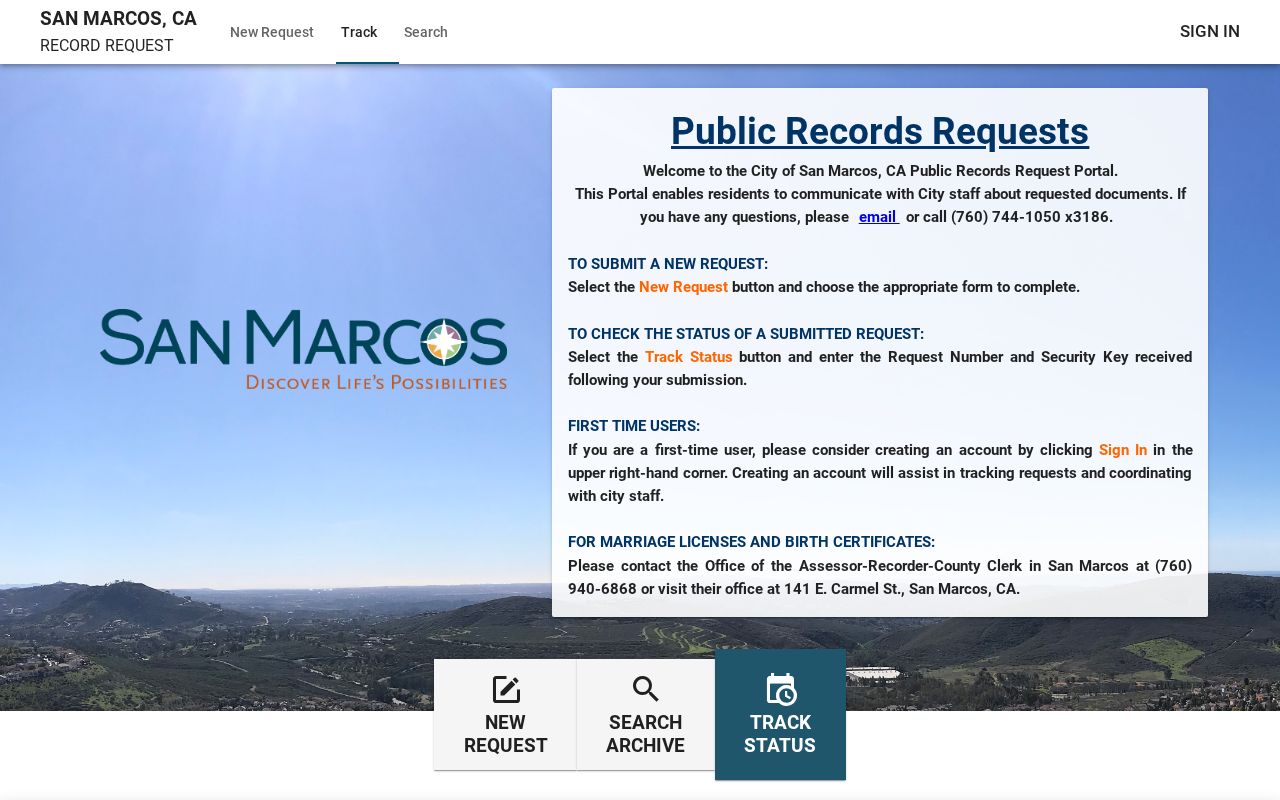
The request portal is the fallback when a block-related city record is not exposed by the current permit interface.
San Marcos Approved Voter Files
California voter information is not open for unrestricted neighbor browsing. My Voter Status is an identity-gated personal tool. A written Registrar application must state an approved election, scholarly, journalistic, political, or governmental purpose under Elections Code sections 2188 and 2194. The application can ask for geography, fields, output media, intended users, security, and return or destruction certification.
The research notes a published one-time county registered-voter file price of $75 and a listed vote-by-mail activity subscription price of $285. Products and prices must be checked against the current form. Potential fields include voter name, residence and mailing address, precinct, party preference, registration status or date, districts, and participation history. Birth-date access, driver-license or state-ID numbers, Social Security numbers, signatures, and confidential-voter data remain limited.
The Registrar's site is the right place to check purpose and application requirements.
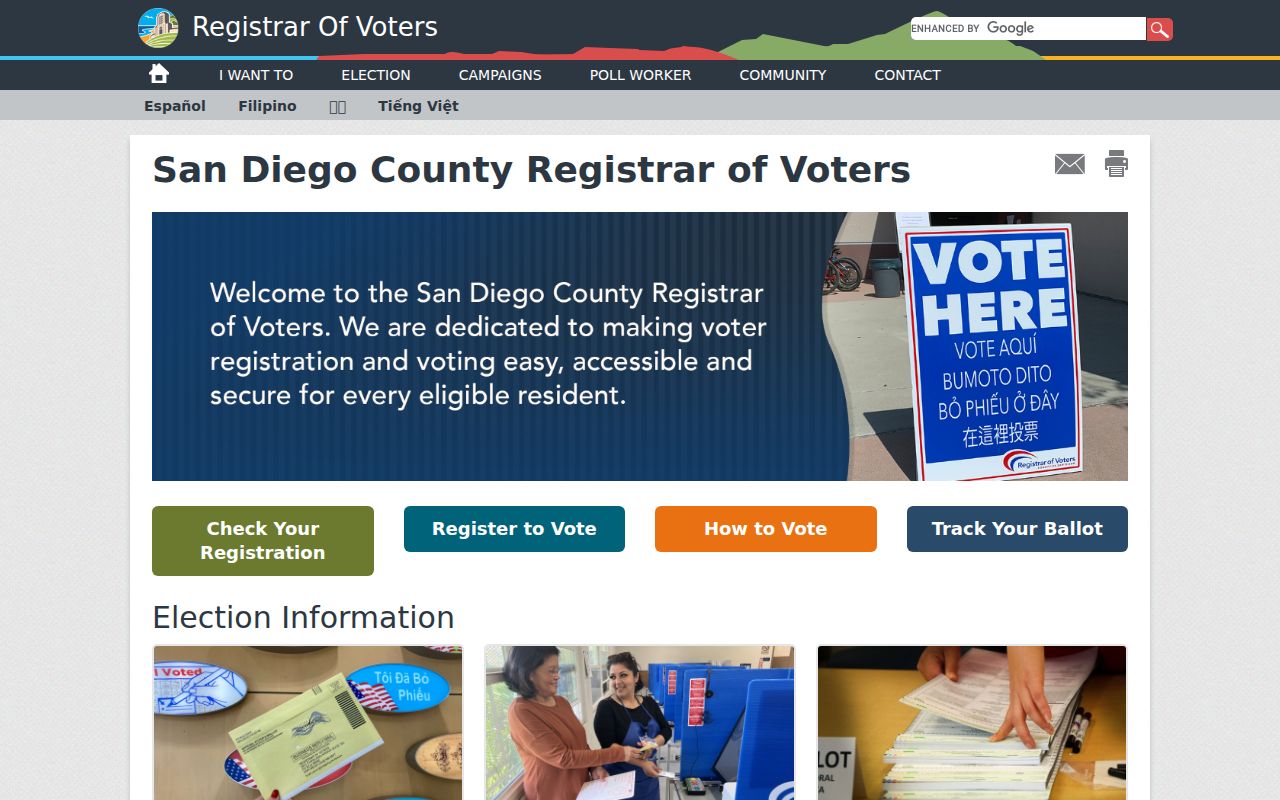
An approved file is a controlled research product, not a casual list of San Marcos neighbors.
San Marcos Community Contacts
San Marcos recognizes communities and master-planned areas including San Elijo Hills, Discovery Hills, Lake San Marcos vicinity, Twin Oaks Valley, Richmar and central San Marcos, Santa Fe Hills, the University District, and Old Creek Ranch. Public association pages may name a board, manager, meeting, event, or contact channel. The research did not locate an official citywide directory that confirms member-roster status.
| Community Layer | Useful Public Clue | Boundary |
|---|---|---|
| Master-planned association | Board or management contact, event, notice | Member roster is not assumed public |
| City commission or meeting | Agenda, appointment, public comment, notice | Shows civic participation, not a home list |
| Neighborhood notice | Public project, meeting, or service information | Use the named source and date |
| Chamber or organization | Business or nonprofit contact | Affiliation is not household membership |
Public contacts help a resident reach a community organization without asking for a private roster. They are the civic layer of a block search.
San Marcos Official Rolls and Neighbor Tools
Commercial neighbor tools can be quick, but their merged data may contain stale addresses, same-name errors, and little record context. Official sources are slower and narrower, yet they identify a custodian, search field, date, and access rule. Use the comparison to choose the next responsible step.
| Category | Strength | Limit |
|---|---|---|
| County GIS | Parcel shape, APN, layers, jurisdiction | No owner-name field in the inspected local layer |
| Assessor or Recorder | Property and recorded-party evidence | Privacy limits; owner is not occupant |
| Approved voter file | Purpose-approved registration geography | Application, statutory purpose, confidential records |
| Commercial people data | Fast merged clue | Stale, same-name, incomplete, and not authoritative |
Do not use a commercial category to evade a closed official source. Return to the custodian whenever a fact matters.
San Marcos City Records Requests
The San Marcos City Clerk accepts city-created record requests through JustFOIA, email at Cityclerk@sanmarcosca.gov, telephone at (760) 744-1050 ext. 3186, and the counter at 1 Civic Center Drive. Under the California Public Records Act, an agency ordinarily makes a disclosure determination within ten days under Government Code section 7922.535, with an unusual-circumstance extension of up to fourteen days. Ask for an existing permit, inspection, agenda, contract, complaint, or dated file.
Give the address or APN, department, record type, and date range. The City need not create a new list of neighbors. Redactions can protect personal details, victims, active investigations, or other exempt material. A focused request makes the block question answerable without asking an agency to compile a household.
For a block history, request the file that records an event at the address, such as an inspection or meeting packet. The response window is a determination window, not a promise that every responsive page will arrive within ten days.
Protected San Marcos Neighbors Stay Hidden
Safe at Home provides a substitute address and confidential voter registration for qualifying survivors and certain public employees. Government Code sections 6205 and following and 6215 and following govern eligibility and agency duties. DMV personal data is restricted by the federal DPPA. Sealed court files, juvenile records, adoption records, confidential marriage records, and protected voter data have separate limits.
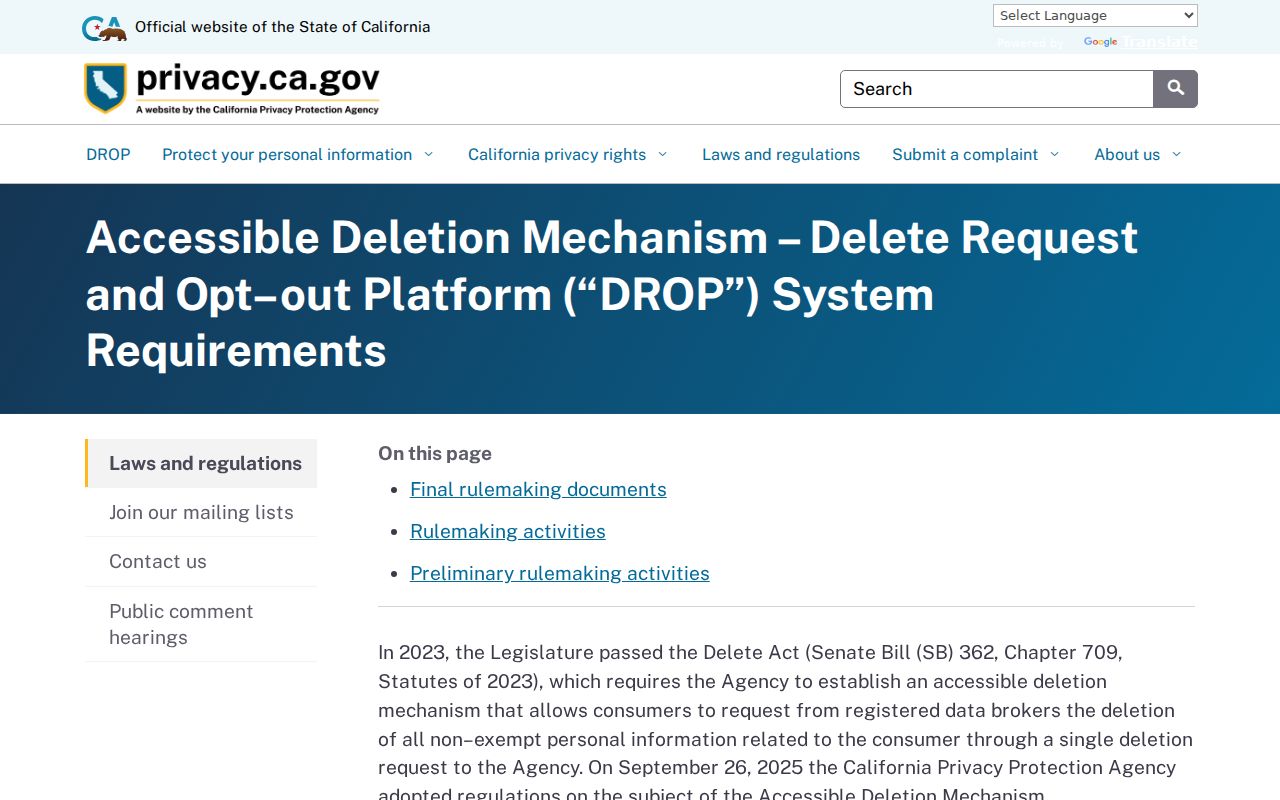
California's consumer privacy and data-broker deletion systems do not erase every public record a government custodian must retain. A deletion request to a broker and a correction or redaction request to a public office are different processes. The state privacy agency's current DROP requirements should be checked before relying on a deletion outcome.
The privacy program requirements explain why a missing name on a neighbor source may be a lawful protection rather than an error.
Respect the source's boundary and do not try to reconstruct a protected address from other clues.
Lawful block research. Use parcel, civic, and community sources for family history, property curiosity, and lawful local questions. Never use them to stalk, harass, intimidate, or harm anyone.